Introduction
One of the most common questions business owners ask about FBR digital invoicing isn’t “how does it work?” — it’s simpler than that: “does this even apply to me?”
The honest answer is that the scope has expanded a lot since the rules were first introduced, and it now reaches well beyond large retailers. Use the checklist below to get a clear answer for your specific business.
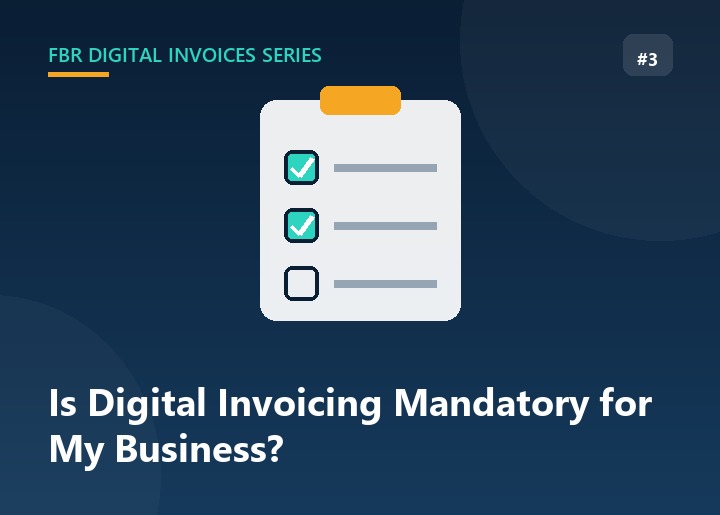
The Checklist
Go through these questions in order. If you answer “yes” to any of them, digital invoicing very likely applies to you.
1. Are you registered for sales tax with FBR? If yes, this is your starting point — the requirement now covers essentially all sales-tax-registered persons, not just large companies.
2. Are you a Tier-1 retailer, wholesaler, importer, or manufacturer? You’re generally considered Tier-1 if any of the following apply:
- You operate in an air-conditioned shopping mall or plaza
- You accept payment through a credit/debit card machine
- Your annual electricity bill exceeds Rs. 1.2 million
- You run a large-format store or are part of a chain of stores
3. Do you operate in one of the specifically notified service sectors? FBR has named a wide range of sectors that must integrate, including:
- Restaurants, hostels, motels, guest houses
- Marriage halls, marquees, and clubs (including race clubs)
- Inter-city road transport, courier, and cargo services
- Photographers, videographers, and event managers
- Accountants and other professional service providers
- Foreign exchange dealers/exchange companies
- Private schools, colleges, universities, and vocational training institutes
- Online sellers and online marketplaces
4. Do you sell online through a marketplace or your own storefront? Online sellers and marketplaces are explicitly included — “I only sell online” is not an exemption on its own.
5. Do any of the above apply, but your annual turnover is under Rs. 200 million? This is the one exception worth knowing about — see below.
The Small Business Exemption, Explained
FBR has proposed a simplified, voluntary tax regime for small shopkeepers that offers an exemption from routine audits, withholding tax obligations, and mandatory digital invoicing — but only if all of the following are true:
- Your annual turnover is Rs. 200 million or less (in each of the preceding three years)
- You own only one shop
- You are not classified as a Tier-1 retailer
- You are not a jeweller
- You are not a professional such as a doctor, engineer, or lawyer
If any of those exclusions apply to you, the simplified regime isn’t available, and the standard mandatory digital invoicing requirement applies.
What Your Answers Mean
- “Yes” to sales tax registration, and you don’t clearly qualify for the small-business exemption → digital invoicing applies to you. Treat it as a current requirement, not a future one.
- “Yes” to Tier-1 status, a notified sector, or online selling → you’re in scope regardless of size, unless the exemption’s strict conditions are all met.
- You genuinely meet every condition of the small-business exemption → you may be able to opt into the simplified regime instead of mandatory integration — but this is worth confirming with a tax advisor given how narrow the conditions are.
If you’re unsure which category you fall into, the safer assumption — given how far the rollout has expanded — is that it applies to you.
What to Do Next
If the checklist above points to “yes,” the next step is making sure your invoicing actually meets FBR’s real-time requirements — real-time transmission, a valid IRN, and a verifiable QR code on every sale. That’s exactly what FBR Digital Invoices is built for: a cloud-based platform that connects your POS or ERP to FBR, validates every invoice in real time, and generates the IRN and QR code automatically — so you’re not left figuring out the integration on your own.
FAQ
I only have one shop and low turnover — am I definitely exempt? Not automatically. You’d need to meet every condition of the small-business exemption (turnover under Rs. 200 million, one shop only, not Tier-1, not a jeweller, not a listed professional). If even one condition isn’t met, standard requirements apply.
Does selling only online make me exempt? No — online sellers and marketplaces are explicitly named as businesses that must integrate.
What if I’m not sure which category I fall into? Given how broadly the requirement now applies, it’s worth confirming your specific status with a tax advisor rather than assuming you’re exempt.
I’ve confirmed I need to comply — what’s the fastest way to get set up? A platform built for FBR integration, like FBR Digital Invoices, handles the real-time reporting, IRN/QR generation, and validation for you, rather than requiring you to build it from scratch.
Conclusion
The scope of mandatory digital invoicing in Pakistan has grown well past “large retailers only” — it now reaches most sales-tax-registered businesses, a long list of named service sectors, and every online seller. The small-business exemption exists, but it’s narrower than most owners assume. If the checklist above puts you in scope, the practical next step is getting properly integrated — and FBR Digital Invoices is built to make that step straightforward.