Introduction
“Tax” gets used as one broad category in everyday conversation, but for a business owner in Pakistan, it’s really two separate obligations running on entirely different tracks — sales tax and income tax. Confusing the two, or assuming that being compliant on one means you’re covered on the other, is one of the more common and costly mix-ups for business owners. Here’s the actual difference, and how it affects what you need to track.
The Core Difference, in One Line
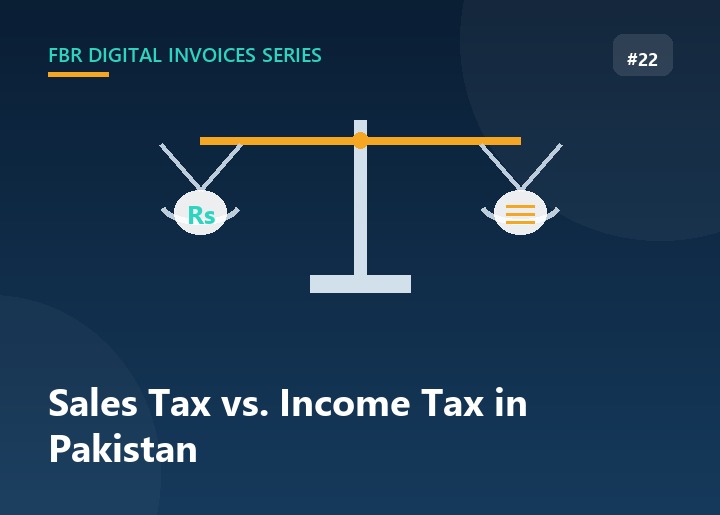
Income tax is a tax on what your business earns. Sales tax is a tax on what your business sells. One is based on profit; the other is based on transactions — and that distinction shapes everything else about how each one works.
Income Tax for Businesses
- What it taxes: your net income — profit after expenses, not total revenue.
- Type: a direct tax — your business (or you personally, for sole proprietors/AOPs) is the one legally liable for it.
- Governed by: the Income Tax Ordinance, 2001.
- Rates: slab-based for individuals (roughly 0–35%), and tiered for companies — standard companies around 29%, small companies around 20%, with reduced rates (roughly 7.5–15%) available for qualifying SMEs.
- Filing frequency: annual — one return per tax year. (We covered the specific Tax Year 2026 deadlines — 30 September for individuals/AOPs, 31 December for companies — in an earlier post.)
Sales Tax for Businesses
- What it taxes: the value of your taxable sales or supplies — what you sell, not what you keep.
- Type: an indirect tax — your customer ultimately bears the cost, but your business is responsible for collecting and remitting it to FBR.
- Governed by: the Sales Tax Act, 1990.
- Rate: a standard 18% on goods, though specific sectors can fall anywhere from 0% to around 19.5% depending on notified exemptions or special rates.
- Registration threshold: generally required once annual turnover exceeds Rs. 10 million.
- Filing frequency: monthly, typically due by the 15th of the following month — and a return is generally still required even in a period with no taxable activity.
This is also the tax that FBR’s digital invoicing requirement directly relates to: the real-time reporting of sales tax invoices is part of meeting this monthly obligation, not a separate system layered on top of it.
The Nuance Most Business Owners Miss: Goods vs. Services
Sales tax on goods is a federal matter, administered by FBR. Sales tax on services, historically, has been a provincial matter — collected by each province’s own revenue authority rather than FBR directly (for example, the Punjab Revenue Authority, Sindh Revenue Board, KP Revenue Authority, or Balochistan Revenue Authority, depending on where the service is rendered).
That used to make the split fairly clean: goods through FBR, services through your province. It’s gotten more tangled recently. FBR’s newer digital invoicing rules — notably the draft SRO 288(I)/2026 — pull a long list of service businesses (restaurants, clinics, salons, transport operators, and more) into FBR’s own real-time invoicing and POS integration system, using the Income Tax Rules as the legal basis rather than the Sales Tax Act. That’s a separate track from provincial sales tax on services, not a replacement for it — and it’s created real friction: provincial revenue authorities have formally objected to the SRO, arguing it duplicates requirements for services already subject to their own sales tax.
The practical takeaway: don’t assume “I run a services business, so sales tax and FBR digital invoicing aren’t my concern.” You may owe provincial sales tax on your services and separately be required to integrate with FBR’s digital invoicing system if your sector is named — these can be two distinct obligations layered on top of each other, not alternatives. Confirming both independently is safer than assuming one covers the other.
Side by Side
| Income Tax | Sales Tax | |
|---|---|---|
| Taxes | Profit / net income | Value of sales or supplies |
| Type | Direct | Indirect (collected from customers) |
| Governing law | Income Tax Ordinance, 2001 | Sales Tax Act, 1990 |
| Filing frequency | Annual | Monthly |
| Standard rate | Slab-based (individuals) / tiered (companies) | 18% (goods, standard) |
| Authority — goods | FBR | FBR |
| Authority — services | FBR | Provincial revenue authority |
Why This Distinction Actually Matters Day to Day
Being diligent about one of these doesn’t automatically mean you’re covered on the other — they run on different calendars, different calculations, and sometimes different authorities entirely. A business can have flawless monthly sales tax filings and still miss its annual income tax deadline, or vice versa. Treating them as one combined “tax compliance” task is exactly what causes deadlines to get missed, since the two don’t share a single due date or a single portal experience end to end.
Where This Connects to Digital Invoicing
FBR digital invoicing — real-time IRN and QR code generation on every sale — started as a sales tax compliance mechanism for goods, and remains the primary way most businesses experience it. But as the “Goods vs. Services” nuance above shows, FBR has also been extending real-time invoicing requirements to service businesses through the Income Tax Rules, so it’s no longer purely a sales tax matter for everyone. Either way, one thing stays true: digital invoicing doesn’t file your income tax return, and being properly integrated for it doesn’t mean your annual income tax obligation is automatically handled. What it does provide is a genuine side benefit: if your sales are already being validated and recorded in real time throughout the year via a platform like FBR Digital Invoices, your revenue records are already organized and centrally available — which makes preparing your separate income tax return considerably less work than reconstructing a year of transactions from scattered records.
FAQ
If I’m registered and compliant for sales tax, do I still need to file income tax separately? Yes — they’re entirely separate filings with separate deadlines. Sales tax compliance doesn’t substitute for your income tax return.
My business only sells services — does FBR digital invoicing still apply to me? Don’t assume it doesn’t. Sales tax on services traditionally falls under your province’s own revenue authority, but FBR’s newer digital invoicing rules separately name many service sectors for federal integration too — check both rather than assuming provincial coverage rules out an FBR obligation.
Which tax is based on my revenue, and which is based on my profit? Sales tax is tied to the value of what you sell (revenue-based); income tax is tied to what’s left after expenses (profit-based).
Do I file sales tax and income tax in the same place? Not necessarily — income tax filing runs through FBR’s IRIS system regardless of business type, but sales tax on services generally runs through a separate provincial authority’s portal instead of FBR’s. A services business may also have a distinct FBR digital invoicing obligation on top of that if its sector is named.
Conclusion
Sales tax and income tax aren’t two names for the same obligation — they tax different things, follow different laws, run on different filing calendars, and for services businesses, can even fall under different authorities entirely. Getting clear on which applies to your specific business, and staying current on both independently, is what actually keeps you compliant — not just being diligent about one and assuming it covers the other.