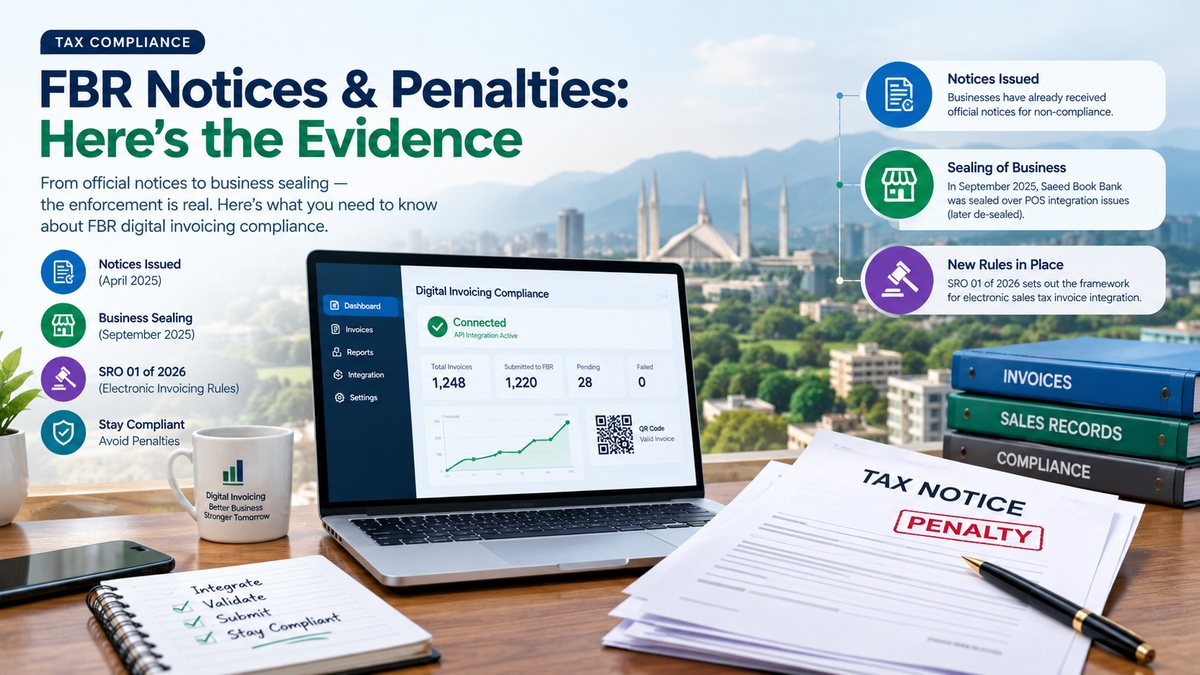
If you are still thinking that FBR Digital Invoicing is just another upcoming compliance requirement, the enforcement record tells a different story.
FBR’s own guidance makes clear that notified registered persons are required to integrate their POS, ERP or invoicing systems through a licensed integrator, and that failure to meet the applicable integration timelines can result in penalties under Section 33 of the Sales Tax Act, 1990.
More importantly, enforcement is not merely theoretical. There are documented cases involving notices, business premises being sealed, and financial penalties related to FBR integration and POS compliance.
For businesses that have not yet completed their digital invoicing setup, the message is straightforward: do not wait for an FBR notice before taking action.
FBR Digital Invoicing Is Already an Enforcement Issue
FBR’s current Digital Invoicing FAQs state that electronic invoicing is mandatory for the registered persons covered by the applicable rules. FBR also says that notified registered persons must integrate their POS, ERP or other invoicing systems through an FBR-licensed integrator.
The same FAQ specifically states that taxpayers who fail to integrate within the Board’s timelines are liable to penalties defined under Section 33 of the Sales Tax Act.
That means digital invoicing should no longer be treated as something businesses can simply postpone indefinitely.
Evidence #1: FBR Issued a Notice Before Sealing Saeed Book Bank
One of the clearest publicly reported examples came from Islamabad.
In September 2025, FBR sealed Saeed Book Bank in Sector F-7 after an issue involving integration of its Point of Sale system with FBR requirements.
According to Dawn, an FBR official said a notice had been issued to the bookstore in April requesting installation of the POS system. After the requested integration was not completed, the premises were sealed by the Regional Tax Office.
The store was subsequently de-sealed after its management gave an assurance of compliance.
The case is important because it demonstrates a sequence that businesses should pay attention to:
Notice → Non-compliance → Enforcement action → Business disruption → Compliance commitment
It also shows that enforcement action can affect established and well-known businesses, not only small or newly established companies.
It is worth noting that the bookstore’s owner disputed the basis of the action and argued that the POS requirement did not apply to the business. That disagreement is part of the publicly reported record and shows why businesses should carefully review the exact legal basis of any notice they receive.
Evidence #2: FBR Collected Rs. 500,000 in a POS Compliance Drive
The enforcement record goes beyond notices.
In September 2025, Dawn reported that FBR’s Dera Ghazi Khan region had sealed 10 business outlets for violating POS-related regulations and collected a Rs. 500,000 fine before unsealing the premises.
The report quoted the Commissioner Inland Revenue as warning businesses that had received notices to install the required POS systems and comply with the applicable requirements.
This is significant for businesses considering whether an FBR notice can simply be ignored.
The evidence shows that enforcement mechanisms have included actual operational restrictions and financial consequences.
Evidence #3: The Courts Have Already Dealt With Integration Penalties
There is also a documented judicial record involving FBR integration requirements.
An Islamabad High Court case concerning a non-integrated Tier-1 retailer described notices requiring the business to install POS software integrated with FBR’s computerized system. After the business remained non-compliant, its premises were sealed and a Rs. 500,000 penalty was imposed for the first default under Section 33(25A).
The case demonstrates that integration-related penalties and sealing are not merely theoretical provisions sitting in legislation.
There is an established enforcement history around FBR’s computerized sales reporting requirements.
What Has Changed With Digital Invoicing?
The newer digital invoicing framework extends the emphasis on electronic reporting.
FBR’s current FAQ states that notified registered persons must integrate their POS, ERP or other invoicing systems through a licensed integrator and transmit sales tax invoices to FBR’s computerized system in real time.
FBR also maintains an official list of licensed integrators for businesses that need to complete the integration process.
The objective is not simply to create an invoice on a computer.
The invoice needs to move through the prescribed electronic process and be reported to FBR.
That creates a much stronger compliance trail.
A PDF Invoice Is Not the Same as an FBR Digital Invoice
This is one of the most important points businesses need to understand.
Generating a PDF invoice from your existing accounting software does not automatically mean that you are compliant with FBR’s electronic invoicing requirements.
FBR explicitly explains that an electronic invoice is a structured digital invoice created using electronic tools in the specified format. Simply scanning or copying a paper invoice into an electronic format does not make it an electronic invoice.
In practical terms:
PDF Invoice
≠
FBR Digital Invoice
The important part is the prescribed integration and electronic transmission process.
What Can Happen If You Ignore the Requirement?
The consequences depend on the applicable legal provision, taxpayer category, facts of the case and the enforcement process involved.
However, the documented record shows that businesses can face:
1. Formal notices
FBR can communicate with businesses regarding compliance and require corrective action.
2. Financial penalties
The Sales Tax Act contains penalty provisions for specified integration and invoicing-related defaults. FBR’s own FAQ confirms that persons failing to meet applicable integration timelines can be subject to Section 33 penalties.
3. Sealing or operational disruption
Previous POS integration enforcement has included sealing of business premises, as documented by both FBR-related legal records and media reports.
4. Additional compliance scrutiny
Once an issue is identified, businesses may have to provide records, respond to notices, demonstrate compliance, or resolve discrepancies.
For this reason, waiting until enforcement reaches your business can be considerably more disruptive than completing the required integration beforehand.
The Important Difference: Notice vs. Penalty
Receiving an FBR notice does not automatically mean that a business has already been finally penalized.
This distinction matters.
A notice may give the taxpayer an opportunity to respond, explain its position, or take corrective action.
The actual consequences depend on the applicable law, the contents of the notice, the taxpayer’s response and the subsequent proceedings.
Businesses should therefore read every FBR notice carefully and obtain professional tax/legal advice where necessary, rather than assuming that every notice has the same meaning.
Why Businesses Should Not Wait
One of the biggest mistakes a business can make is waiting for someone from FBR to contact them.
By the time a notice arrives, the business may already have:
- missed the applicable integration timeline
- accumulated invoices outside the required system
- incorrect customer or tax information
- failed invoice submissions
- reconciliation problems
- incomplete digital records
- difficulty proving when integration became operational
Getting the system ready before enforcement reaches the business gives the accounts team time to test everything properly.
How to Check Whether Your Business Is Really Compliant
If you already have an invoicing system, don’t assume that having software installed means you are fully compliant.
Check the following:
Step 1: Confirm your applicability
Determine whether your business falls within the categories covered by the applicable FBR digital invoicing requirements.
Step 2: Verify your integration
Confirm that your POS, ERP or invoicing system is connected through the prescribed integration route.
Step 3: Check your FBR responses
Make sure invoices are actually being transmitted and that successful responses are being received.
Step 4: Review failed invoices
Don’t ignore rejected or failed invoices.
Identify the reason and resolve the problem.
Step 5: Reconcile your records
Compare:
POS/ERP Sales → Digital Invoices → FBR Submission → Accounting Records
Any unexplained difference should be investigated.
Step 6: Keep evidence
Maintain records of:
- Integration date
- Testing
- Invoice numbers
- FBR responses
- Failed submissions
- Corrections
- System logs
- Communications with your integrator
This documentation can become valuable if your business ever needs to demonstrate its compliance history.
What Businesses Should Do Now
If your business has not completed FBR Digital Invoicing integration, now is the time to check your position.
You should:
1. Confirm your FBR requirements
2. Select an appropriate licensed integration route
3. Connect your existing POS, ERP or invoicing system
4. Test the integration
5. Start issuing invoices through the required process
6. Monitor successful and failed submissions
7. Keep proper digital records
8. Train your accounts and sales staff
Most importantly, don’t confuse “we have software” with “we are compliant.”
Compliance requires the complete process to work correctly.
FBR Digital Invoicing Is Moving From Preparation to Enforcement
The evidence is already available.
FBR’s own guidance provides for penalties when applicable integration requirements are not met.
Publicly documented cases show that FBR has issued notices and taken enforcement action against businesses over integration and POS compliance.
And judicial records show that integration-related penalties and sealing proceedings have already been considered by the courts.
There is therefore little reason for a business to wait for an enforcement notice before reviewing its digital invoicing setup.
The question is no longer simply “When will FBR start enforcing?”
The more useful question is:
“Is my business ready if FBR checks us tomorrow?”
Make Your FBR Digital Invoicing Ready
A reliable FBR digital invoicing system should do more than create attractive invoices.
It should help your business:
- Generate digital invoices
- Validate invoice information
- Connect with FBR
- Transmit invoices electronically
- Track invoice status
- Generate required invoice information
- Maintain records
- Identify failed submissions
- Support your accounts team
With the right setup, businesses can move from manual invoicing to a structured digital workflow without having to replace their entire business operation.
Don’t wait for an FBR notice to discover that your invoicing system isn’t ready.
Get your FBR Digital Invoicing setup checked, integrated and properly tested.
Important Note
FBR requirements, deadlines, procedures and penalties can change through new notifications, rules, SROs and amendments. This article is intended for general business awareness and should not be treated as legal or tax advice.
Businesses should verify their current obligations against the latest FBR rules and, where necessary, consult a qualified tax professional.
Official FBR Resources
FBR Digital Invoicing FAQs
FBR Digital Invoicing Legal Provisions
FBR Licensed Integrators
FBR Digital Invoicing Technical Documentation
Sources
- FBR de-seals capital’s largest book shop — DAWN.COM
- Saeed Book Bank back in business — The Express Tribune
- Renowned Islamabad Bookstore De-Sealed Following FBR Action — ProPakistani
- Digital invoicing system: FBR to crack down on non-compliant importers from July 1 — Business Recorder
- FBR Deploys New Powers to Punish Tax Dodgers Avoiding Digital Monitoring — TechJuice