Introduction
The deadlines for FBR digital invoicing haven’t been a single date — they’ve rolled out in waves, by business size and sector, since late 2025. That’s made it easy for a lot of business owners to lose track of where their specific category actually stands. If you’ve been putting off integration because “the deadline” felt vague, this is the moment to check — because for many businesses, it has already passed.
The Timeline So Far
Late 2025 — the first phase. Under SRO 1852(I)/2025, FBR rolled out digital invoicing integration in phases based on business size: large companies and importers first, followed by mid-size companies, then small companies and remaining registered persons. That phased schedule reached its final compliance point by the end of 2025, with FBR beginning to issue enforcement notices to corporates and importers shortly after.
Early 2026 — enforcement widens. From January 2026, enforcement extended more broadly across registered persons, not just the largest businesses that went first.
July 2026 — the broader mandatory deadline. FBR set July 1, 2026 as the point by which all liable businesses were expected to have adopted digital invoicing, with penalty warnings issued ahead of that date for anyone who hadn’t integrated.
February 2026 — a new wave incoming. SRO 288(I)/2026 was issued as a draft notification proposing to bring a long list of additional sectors into scope — restaurants, hostels, motels, marriage halls, clubs, transport and courier services, photographers and event managers, accountants, retailers, forex dealers, private schools and colleges, and select medical service providers, among others. As a draft, it isn’t enforceable yet — it becomes binding only once FBR issues a final notification and a follow-up General Order with specific implementation dates. If your business falls into one of these newly named categories, it’s worth watching for that final notification closely, since the timeline could move quickly once it lands.
Where that leaves us today: if your business was already required to integrate under the 2025 phased rollout or the July 2026 deadline and hasn’t yet, you’re not early anymore — you’re overdue.
Are You Already Late? A Quick Gut-Check
- Was your business notified or contacted by FBR/PRAL about integration, and you haven’t completed it? → Late.
- Are you a Tier-1 retailer, wholesaler, importer, or manufacturer that hasn’t integrated? → Very likely late — this category was first in line.
- Are you a sales-tax-registered business of any size that still hasn’t integrated as of today? → At risk, given the broader deadline has already passed.
- Do you fall into one of the newly listed sectors under the SRO 288(I)/2026 draft (restaurants, clubs, schools, salons, diagnostic labs, etc.)? → Not yet overdue, but the window to prepare is closing — final rules could take effect on short notice.
If any of the first three apply to you, treat this as urgent rather than something to schedule for “next quarter.”
What Happens If You’re Late
This isn’t a soft deadline with an informal grace period. The consequences compound the longer integration is delayed:
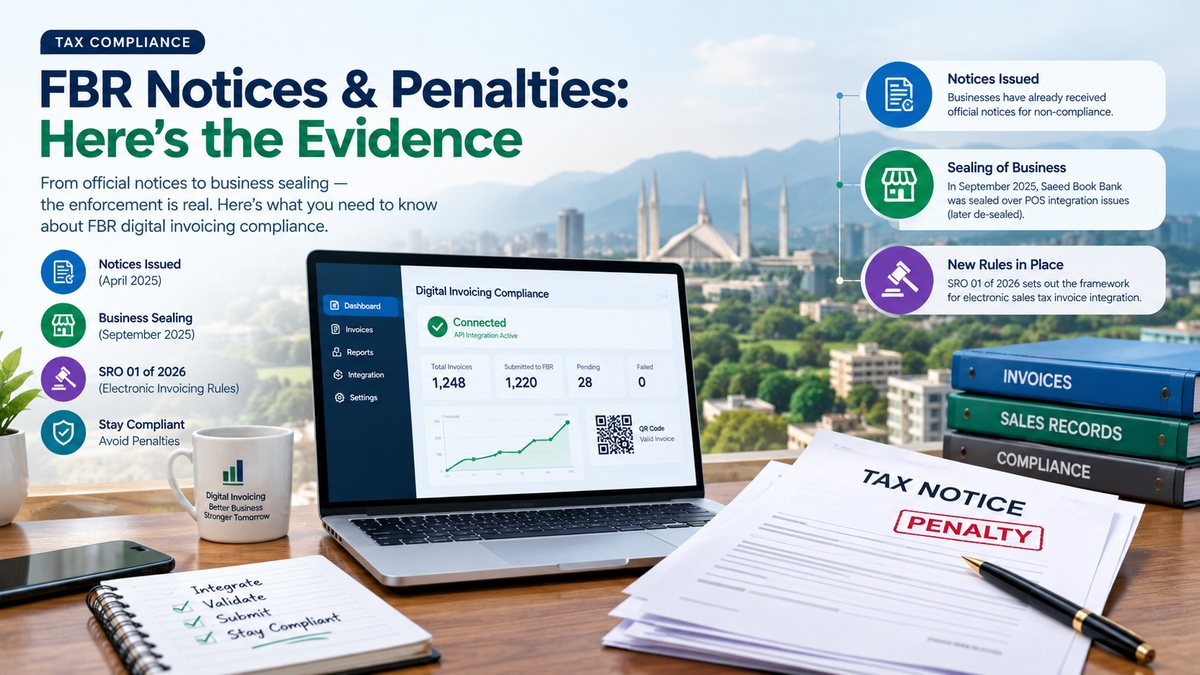
- Financial penalties. A first default for failing to integrate can carry a penalty in the range of Rs. 500,000, with penalties escalating — up to Rs. 1–3 million — for continued non-compliance.
- Invalid invoices. Invoices issued outside FBR’s integrated system are treated as legally invalid.
- Downstream damage to relationships. Because your invoices aren’t valid, your customers can’t use them to support their own input tax claims — which puts strain on business relationships with other registered businesses, not just your own compliance record.
- Increased audit exposure. FBR has been actively expanding its audit and enforcement capacity, meaning non-integrated businesses are more likely to be flagged, not less.
What to Do If You’re Behind
Being late doesn’t mean the situation is unrecoverable — it means the priority is closing the gap as fast as possible, not waiting for a “better time.”
- Confirm your exact category and obligation. Deadlines and requirements vary by business type, turnover, and sector — if you’re unsure exactly where you stand, a tax advisor can confirm it quickly.
- Get integrated properly, not partially. A QR code or invoice number that isn’t backed by a real, live FBR submission doesn’t count — and can create the appearance of compliance without the substance.
- Move quickly, but don’t rush into the wrong setup. Building and testing your own integration from scratch takes time you may not have if you’re already overdue.
This is exactly the gap FBR Digital Invoices is built to close quickly — a cloud-based platform that connects to your existing POS or ERP, handles real-time FBR validation, and generates a compliant IRN and QR code on every invoice, without requiring you to build the integration yourself.
FAQ
I never received a notice from FBR — does that mean I’m not required to integrate? Not necessarily. The requirement is based on your business category and registration status, not on whether you’ve personally received a notice. It’s worth confirming your obligation directly rather than waiting to be contacted.
Is there a grace period if I start now? FBR’s messaging around the mandatory deadlines has been firm rather than lenient — the safer assumption is that penalties can apply from the point your specific deadline passed, not from when you eventually get around to it.
My business falls under the new SRO 288(I)/2026 categories — do I need to act now? The draft isn’t enforceable yet, but given how quickly previous phases moved from notification to enforcement, it’s worth getting your integration groundwork in place before the final notification lands rather than after.
What’s the fastest way to catch up if I’m already late? Using an established platform like FBR Digital Invoices to handle the technical integration, rather than starting the process from scratch.
Conclusion
FBR’s digital invoicing deadlines haven’t been one date — they’ve been a moving timeline that’s already passed for a large share of businesses. If you’re not sure where you stand, the safest move is to assume you may already be behind and act accordingly. The sooner you close that gap — with a platform like FBR Digital Invoices — the smaller the exposure to penalties and audit risk.
Sources
- FBR mandates phased integration of electronic invoicing system for sales tax-registered entities — Profit by Pakistan Today
- FBR directs integration of e-invoicing with income tax system for specified businesses — Profit by Pakistan Today
- FBR directs businesses, professionals to integrate e-invoicing with income tax system — Business Recorder