Introduction
On 18 February 2026, FBR published a draft notification — SRO 288(I)/2026 — that goes well beyond the digital invoicing rules retailers had already been adjusting to. It introduces a new chapter to the Income Tax Rules called “Online Integration of Businesses,” and if you run a retail outlet or POS-based business, several parts of it directly change how you’re expected to operate — not just how you invoice.
Here’s what’s actually in it, and what it means specifically for retail and POS businesses.
What SRO 288(I)/2026 Is
It’s a draft amendment to the Income Tax Rules, 2002, covering electronic invoicing, POS integration, QR codes, real-time sales reporting, a new licensing system for integration providers, CCTV requirements, and penalties for non-compliance. As of publication, it remains a draft, open to feedback — it becomes enforceable only once FBR issues a final notification, followed by a General Order specifying implementation timelines.
That said, the direction is unambiguous: FBR wants every notified sale documented digitally and verifiable in real time, and retail is squarely in scope.
What Changes for Retail & POS Businesses
1. Every outlet and POS must be registered with FBR before it can sell. Under the draft rules, integrated businesses must provide FBR’s online system with information about their outlets and points of sale. No supply may be made except through an outlet, POS, or invoice-issuing machine that’s actually integrated. In practice, this shifts the requirement from “report your sales” to “you can’t legally sell without an integrated system in place.”
2. Real-time QR-coded invoices become the standard, not the exception. This continues the direction FBR has been moving in, but the draft framework makes it explicit as a condition of the outlet being allowed to operate at all.
3. CCTV at the point of sale. FBR may require integrated businesses to install CCTV cameras at each point of sale and retain the recordings for at least one month, producing them to the Commissioner if demanded. For retail outlets that don’t already have this in place, it’s a new operational requirement, not just a paperwork change.
4. You won’t be able to use just any invoicing vendor. The draft introduces a formal licensing regime for integrators — the companies and platforms that connect your POS to FBR. To be licensed, an integrator must hold a five-year, non-transferable license from FBR, demonstrate technical capacity, submit three years of audited financial statements, maintain at least Rs. 10 million in paid-up capital, and confirm no history of fiscal fraud or blacklisting. PRAL is expected to act as one such licensed integrator. In practical terms: once this is finalized, the vendor you use for FBR integration will need to be a properly licensed one — this is worth keeping in mind when choosing or continuing with an invoicing platform.
5. The list of covered retail-adjacent businesses keeps growing. Beyond core retailers, the draft also names restaurants, hotels, guest houses, marriage halls, clubs, beauty parlours, clinics and other medical service providers, courier and cargo services, inter-city transport, accounting firms, and private schools above a fee threshold — many of which operate their own point-of-sale systems and would face the same requirements as traditional retail.
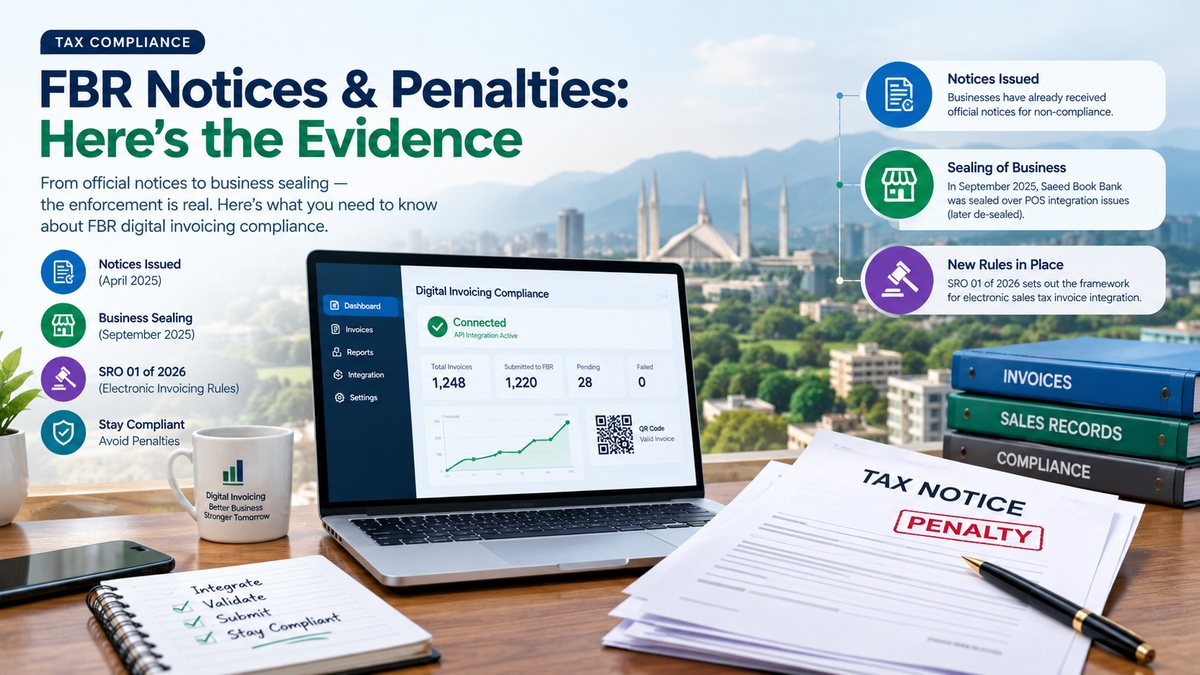
6. Non-compliance penalties are tied to the Income Tax Ordinance, not just the Sales Tax Act. Selling without integrated invoicing, or otherwise violating the framework, can trigger penalty action under Section 182 of the Income Tax Ordinance, alongside possible business restrictions — an additional layer on top of the Sales Tax Act penalties already in place.
It’s a Draft — So What Should You Actually Do Right Now?
Because SRO 288(I)/2026 hasn’t been finalized, there’s no fixed deadline to hit yet for the new provisions specifically. But treating that as a reason to wait is a mistake, for two reasons:
- FBR’s previous phases have moved from draft to enforcement faster than most businesses expected.
- If you’re already required to integrate under the existing rules, none of that obligation is paused by this draft — it’s an addition, not a replacement.
The practical move is to make sure your current POS/invoicing setup is genuinely compliant today, and keep an eye on the final notification so you’re not caught off guard by CCTV or licensed-integrator requirements once they take effect.
Getting Ready
This is exactly the kind of shifting requirement that’s hard to track and implement on your own while also running a retail business. FBR Digital Invoices connects your existing POS or ERP to FBR, handles real-time validation and QR/IRN generation on every sale, and keeps your outlet’s integration aligned with FBR’s current requirements — so as the framework moves from draft to final, your business isn’t scrambling to catch up.
FAQ
Is SRO 288(I)/2026 already in effect? No — as of publication it’s a draft notification, open to feedback. It becomes binding once FBR issues a final notification and a follow-up General Order with implementation dates.
Do I need CCTV at my point of sale right now? Not yet under this specific draft, but it’s a proposed requirement worth planning for if you’re a retail or POS-based business, since it could take effect on relatively short notice once finalized.
Can I keep using my current invoicing vendor once the licensing rule takes effect? Only if that vendor obtains (or already holds) a valid license from FBR under the new regime — this is worth confirming directly with your vendor as the rules are finalized.
Does this replace the digital invoicing requirements I already have to meet? No — it adds to them. Existing obligations under the current digital invoicing rules still apply regardless of where this draft framework stands.
Conclusion
SRO 288(I)/2026 signals where FBR is heading for retail and POS businesses: registered outlets, real-time QR invoices, CCTV oversight, and a formal licensing system for the vendors that connect you to FBR. None of it is final yet, but none of it is likely to stay a draft for long either. The businesses that come out ahead will be the ones whose invoicing setup is already solid today — which is exactly what FBR Digital Invoices is built to keep in place as the rules evolve.