Introduction
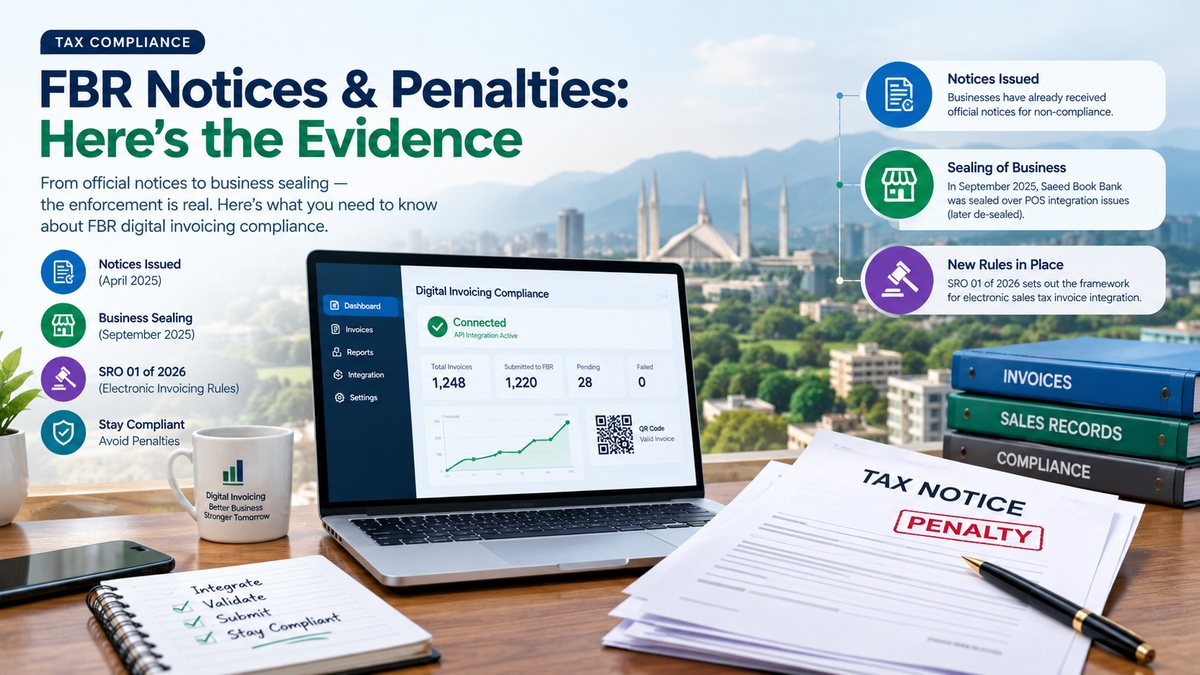
Missing a filing deadline usually means a late fee and moving on. Missing the FBR digital invoicing integration deadline works differently — it doesn’t resolve itself, and the consequences compound the longer it goes unaddressed. If you’ve missed your deadline (or aren’t sure whether you have), this is what actually happens, step by step.
Step 1: Financial Penalties Start Immediately
Under Section 25A of the Sales Tax Act, 1990, FBR is legally empowered to issue penalties to any registered business that fails to start issuing electronic invoices carrying a valid FBR invoice number, QR code, and logo.
- First default: a penalty of Rs. 500,000
- Continued non-compliance: penalties escalate — reported at Rs. 1,000,000, then Rs. 2,000,000, up to Rs. 3,000,000 for repeated defaults
Separately, under Section 33 of the same Act, failing to issue a proper digital invoice carries its own flat fine — Rs. 50,000 or 2% of the tax involved, whichever is greater — with late or rejected invoices attracting an additional Rs. 25,000 per day.
These aren’t one-time fines you pay and clear. They stack the longer integration is delayed.
Step 2: Every Invoice You Issue Is Legally Invalid
This is the part that surprises most business owners: it’s not just about penalties. Invoices issued outside FBR’s integrated system are treated as legally invalid — regardless of how professional they look or whether tax was correctly calculated.
That has a direct knock-on effect: your customers can’t use those invoices to support their own input tax claims. For any business that sells to other registered businesses, this isn’t just a compliance problem — it’s a reason for customers to start looking elsewhere.
Step 3: Enforcement Escalates the Longer It’s Ignored
If non-compliance continues, FBR’s response moves beyond fines:
- Sealing of premises can occur if non-compliance continues for around two months.
- Suspension of sales tax registration has been used as an enforcement tool against non-compliant businesses, particularly importers.
- Removal from expedited processing (such as the “green channel” at import stage) for importers who remain non-compliant.
- Increased audit exposure and ATL risk — non-integrated businesses are more likely to be flagged for review, and repeated non-compliance can affect your Active Taxpayer List status.
At this stage, the issue is no longer a fine you can absorb as a cost of doing business — it starts affecting your ability to operate normally.
Step 4: The Gap Gets Harder to Close Retroactively
Every day without integration is a day of transactions that weren’t properly reported. Catching up isn’t just about turning integration on going forward — it can also mean addressing the compliance gap for the period you were out of scope, which is a very different (and more stressful) conversation with a tax advisor than getting ahead of it would have been.
How to Recover If You’ve Already Missed It
The instinct to wait for a “better time” to deal with this is exactly what makes the situation worse. If you’re already behind:
- Stop the clock on further penalties first. Every additional day of non-integration adds to the exposure — prioritize getting a compliant system live over getting it perfect.
- Get a real integration, not a workaround. A QR code without a genuine, live FBR submission behind it doesn’t protect you from any of the consequences above.
- Talk to a tax advisor about the gap period, separately from fixing the system going forward.
For the technical side, FBR Digital Invoices is built to get businesses compliant quickly — connecting to your existing POS or ERP, validating every invoice with FBR in real time, and issuing a proper IRN and QR code on each sale, so you’re not building an integration from scratch while penalties continue to accrue.
FAQ
If I integrate today, do past penalties go away? No — integrating stops the ongoing accrual of new penalties and invalid invoices, but it doesn’t retroactively resolve issues from the period you were non-compliant. That’s a separate conversation with a tax advisor.
Can FBR really suspend my sales tax registration over this? Registration suspension has been used as an enforcement mechanism for continued non-compliance, particularly for importers — it’s a real risk the longer integration is delayed, not a theoretical one.
Is it worse to integrate late or not integrate at all? Integrating late is always better than not integrating — penalties and risk continue to grow for every day you remain non-compliant, so acting now limits further exposure even if you’re already behind.
How quickly can I actually get compliant if I’m starting from zero? A platform built specifically for FBR integration, like FBR Digital Invoices, is designed to get you connected and validating invoices in real time far faster than building the integration in-house.
Conclusion
Missing the FBR integration deadline isn’t a single event — it’s the start of an escalating chain: financial penalties, invalid invoices, strained business relationships, and eventually operational restrictions like registration suspension or sealed premises. None of it resolves on its own, and all of it gets more expensive the longer it’s left unaddressed. If you’re behind, the priority is closing the gap now — and FBR Digital Invoices is built to help you do that quickly.