FBR vs PRA digital invoicing is one of the most common points of confusion for businesses in Pakistan. FBR Digital Invoicing, PRA Digital Invoicing, FBR POS Integration and PRA POS Integration all involve sending invoice data to a tax authority, but they are run by different authorities, under different laws, for different types of transactions.
Are these systems the same? Does a manufacturer need POS integration? Does a restaurant in Lahore need FBR or PRA? Can one software handle all of them? This guide answers those questions with a side-by-side comparison, real business examples and a quick checklist.
Quick Answer: FBR vs PRA Digital Invoicing in One Minute
- FBR Digital Invoicing – federal sales tax on goods. Sales tax-registered manufacturers, importers, wholesalers and distributors send each sales tax invoice to FBR through an API.
- PRA Digital Invoicing – Punjab sales tax on services. Service providers registered with the Punjab Revenue Authority report service invoices to PRA’s electronic system.
- FBR POS Integration – federal sales tax on retail sales. Notified Tier-1 retailers connect their point-of-sale (POS) to FBR so every customer receipt is reported in real time.
- PRA POS Integration – Punjab sales tax on services sold over the counter. Restaurants, hotels, marriage halls and similar businesses connect their POS to PRA’s e-Invoice Monitoring System (e-IMS).
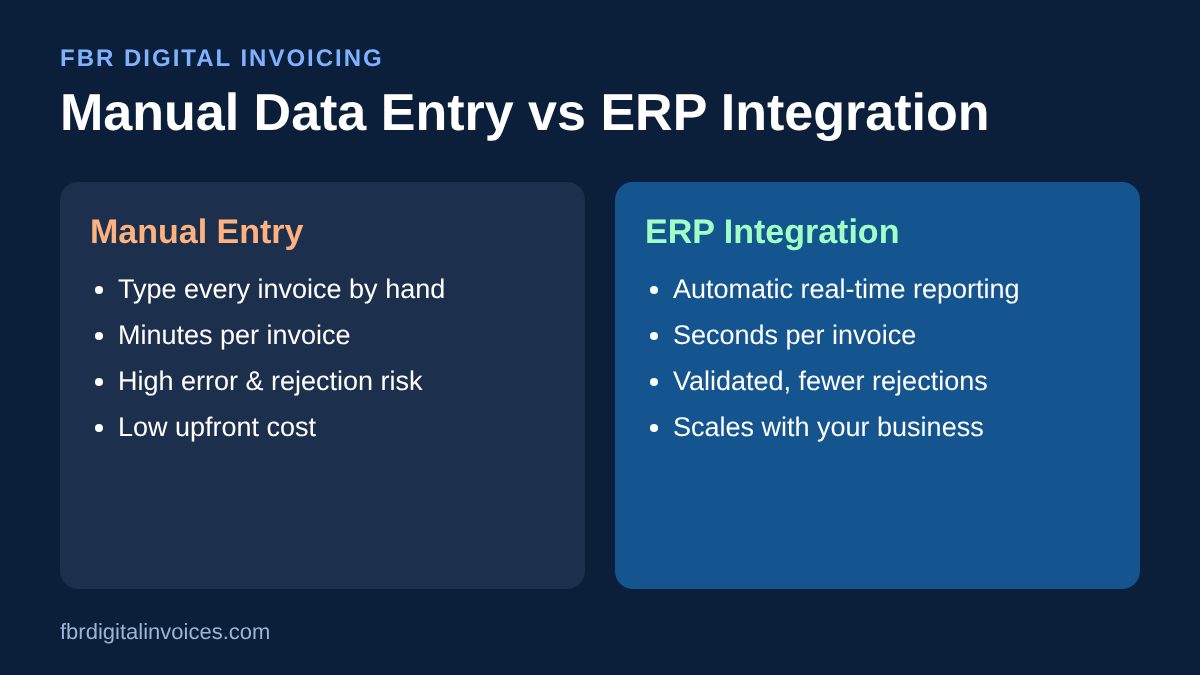
Rule of thumb: FBR = goods (federal), PRA = services in Punjab (provincial). “Digital invoicing” usually means business invoices from an ERP or billing system; “POS integration” means customer receipts printed at a counter. Many businesses need more than one.
1. What Is FBR Digital Invoicing?
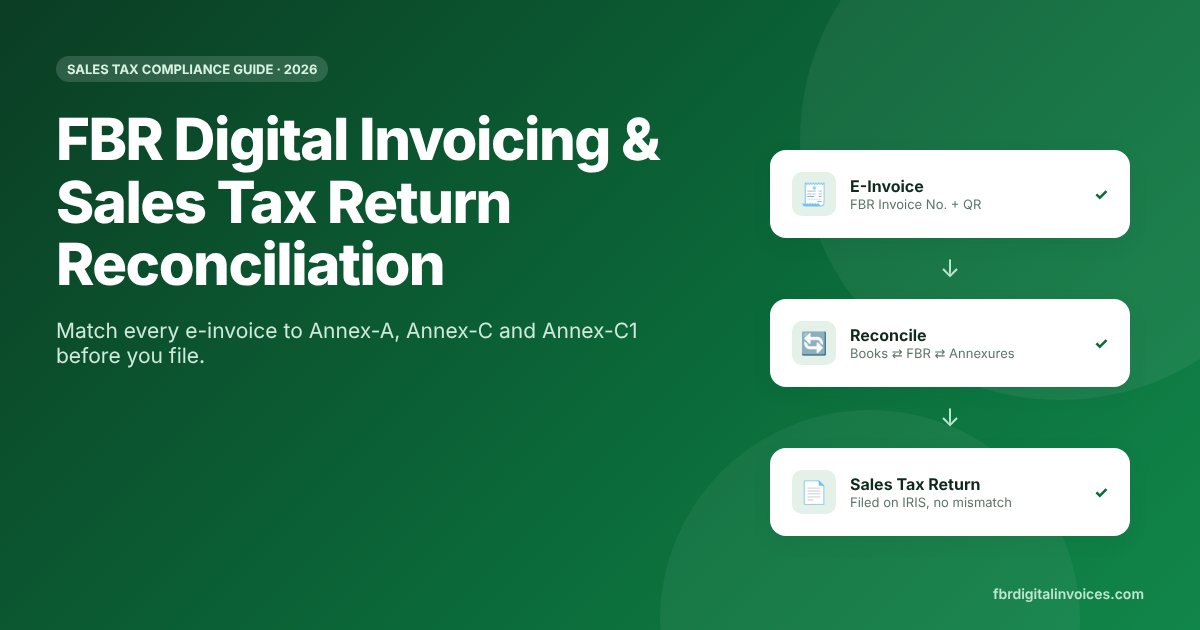
FBR Digital Invoicing is the electronic invoicing system of the Federal Board of Revenue (FBR). It requires sales tax-registered businesses to generate structured sales tax invoices and transmit them to FBR in real time, before or at the time the invoice is issued.
It applies mainly to businesses such as:
- Manufacturers
- Importers and exporters
- Wholesalers and distributors
- Commercial suppliers
- Other sales tax-registered persons notified for integration
Businesses can keep their existing ERP, accounting or invoicing software and connect it to FBR either through an FBR-authorised Licensed Integrator or in-house integration.
Key Features of FBR Digital Invoicing
- Electronic generation of structured sales tax invoices
- Integration with FBR through an API
- Real-time invoice reporting and validation before submission
- FBR invoice reference number (IRN) and QR code on every invoice
- Buyer and seller NTN/STRN details and correct HS codes
- Digital handling of debit and credit notes
FBR’s electronic invoicing requirements are governed by the Sales Tax Act, 1990 and Chapter XIV of the Sales Tax Rules, 2006, as amended through FBR notifications. See the official FBR Digital Invoicing FAQs and our FBR digital invoicing deadlines for 2026.
2. What Is PRA Digital Invoicing?
PRA Digital Invoicing refers to the electronic invoicing and integration requirements of the Punjab Revenue Authority (PRA) for businesses providing taxable services in Punjab. It operates under the Punjab Sales Tax on Services Act, 2012, which is completely separate from federal sales tax law.
Businesses that may need to evaluate PRA integration include:
- Restaurants, cafés, bakeries and caterers
- Hotels, guest houses and marriage halls
- Consultants and professional service providers
- Advertising and marketing agencies
- IT and software service providers
- Other taxable service providers registered with PRA
Key Features of PRA Digital Invoicing
- Electronic reporting of taxable service invoices
- Integration of billing or accounting software with PRA’s system
- Automatic transmission of invoice data
- Tax calculation at the applicable provincial rate
- Digital record-keeping and verifiable invoices
Important: PRA and FBR are separate tax authorities. Being integrated with FBR does not mean you have met your PRA obligations, and vice versa. Confirm your registrations and integration obligations with your tax consultant or the relevant authority.
3. What Is FBR POS Integration?
FBR POS Integration is a separate system for notified Tier-1 retailers. These retailers must connect their point-of-sale systems with FBR so that every retail sale is reported in real time and the customer receives an FBR-verifiable receipt.
Who May Require FBR POS Integration?
Depending on the legal criteria for Tier-1 retailers (such as being part of a chain, location in specified malls or plazas, shop area or electricity consumption), this can include:
- Large retail stores and supermarkets
- Departmental and chain stores
- Branded outlets in malls and plazas
- Other retail outlets in FBR’s notified categories
Key Features of FBR POS Integration
- Integration of retail billing software with FBR
- Real-time reporting of every retail transaction
- FBR invoice number and QR code on customer receipts
- Customer verification of receipts (for example through FBR’s Tax Asaan app)
- Improved transparency in sales tax reporting
FBR POS integration is not another name for digital invoicing. It has its own legal provisions and technical requirements. See the official FBR POS legal provisions and our article on the FBR 2026 framework for retail POS.
4. What Is PRA POS Integration?
PRA POS Integration connects a business’s point-of-sale or billing system with the Punjab Revenue Authority’s e-Invoice Monitoring System (e-IMS). Each bill issued to a customer is reported to PRA and carries a PRA invoice number and QR code.
It is mainly relevant to service businesses in Punjab that deal directly with customers, such as restaurants, hotels, marriage halls, beauty salons and similar businesses falling under PRA’s notified categories. PRA has also moved to discourage handwritten or non-integrated receipts in these sectors.
Key Features of PRA POS Integration
- Electronic billing at the point of sale
- Integration with PRA’s e-IMS
- Real-time reporting of taxable service transactions
- Tax-compliant customer receipts with PRA invoice number and QR code
- Digital transaction records for audits
PRA’s rules, categories and technical procedures differ from FBR’s, so always check the latest requirements on the PRA e-portal.
5. FBR vs PRA Digital Invoicing vs POS Integration: Comparison Table
| Feature | FBR Digital Invoicing | PRA Digital Invoicing | FBR POS Integration | PRA POS Integration |
|---|---|---|---|---|
| Tax authority | Federal Board of Revenue | Punjab Revenue Authority | Federal Board of Revenue | Punjab Revenue Authority |
| Main law | Sales Tax Act, 1990 & Sales Tax Rules, 2006 | Punjab Sales Tax on Services Act, 2012 | Sales Tax Act, 1990 (Tier-1 retailer provisions) | Punjab Sales Tax on Services Act, 2012 |
| Tax covered | Federal sales tax on goods | Provincial sales tax on services | Federal sales tax on retail sales of goods | Provincial sales tax on services |
| Typical transaction | Business invoices (mainly B2B) | Service invoices | Customer receipts (B2C) | Customer bills (B2C) |
| Typical businesses | Manufacturers, importers, distributors, wholesalers | Consultants, agencies, IT and other service providers | Tier-1 retailers, chain stores, supermarkets | Restaurants, hotels, marriage halls, salons |
| System connected | ERP / accounting / invoicing software | Billing / accounting software | Retail POS | Restaurant or service POS |
| Proof on invoice | FBR IRN + QR code | PRA invoice number + QR code | FBR POS invoice number + QR code | PRA invoice number + QR code |
Note: Integration requirements depend on your business activity, registrations and the notifications issued by each authority. This table is a general guide, not a legal determination.
6. Which One Does Your Business Need? Quick Checklist
- You sell goods and are registered for federal sales tax → check whether FBR Digital Invoicing is mandatory for you.
- You are a notified Tier-1 retailer → FBR POS Integration for your outlets.
- You provide taxable services in Punjab → PRA Digital Invoicing / PRA registration.
- You run a restaurant, hotel or similar business in Punjab → PRA POS Integration (e-IMS).
- You sell both goods and services, or operate both wholesale and retail → you may need more than one integration.
- You operate outside Punjab → provincial services tax is handled by your own province’s authority (e.g. SRB in Sindh, KPRA in Khyber Pakhtunkhwa, BRA in Balochistan), each with its own rules.
7. Can a Business Need Both Digital Invoicing and POS Integration?
Yes. Many businesses need multiple integrations depending on their activities and registrations.
Example 1: Manufacturer or Distributor
A manufacturer or distributor registered for federal sales tax may need FBR Digital Invoicing for its sales tax invoices. If it also runs retail outlets that qualify as Tier-1 retailers, FBR POS Integration may apply to those outlets too.
Example 2: Restaurant in Punjab
A restaurant in Lahore providing taxable services will typically need to comply with PRA’s POS / e-IMS requirements. If the same business also supplies packaged goods and is registered for federal sales tax, it should separately evaluate FBR Digital Invoicing.
Example 3: Retail Chain
A retail chain may need FBR POS Integration for its notified outlets and FBR Digital Invoicing for its business-to-business sales, such as bulk supplies to corporate buyers.
The right solution depends on what the business actually does, not just on the software it currently uses.
8. Common Mistakes When Comparing FBR and PRA Integration
- Assuming FBR integration also covers PRA (or the other way round).
- Treating FBR POS Integration and FBR Digital Invoicing as the same requirement.
- Using wrong HS codes, service classifications or tax rates in invoices.
- Ignoring failed or rejected submissions, which can lead to notices and penalties.
- Choosing software that supports only one authority when the business needs both.
9. Why Choosing the Right Integration Software Matters
Tax integration is not just about sending invoice data to a government portal. A reliable FBR and PRA integration solution should provide:
- Regulatory compliance: correct implementation of each authority’s technical and legal requirements.
- Accurate tax calculations: correct tax rates, HS codes, service classifications and invoice details.
- Invoice validation: errors caught before submission.
- Reliable integration: proper handling of API errors, retries and offline or failed submissions.
- Data security: protection of business data and tax credentials.
- Reporting and reconciliation: easy access to invoice records and sales tax reports.
- Technical support: help with integration issues, updates and compliance changes.
- Scalability: support for growing volumes and multiple branches.
For a detailed comparison of providers, read best FBR digital invoicing software in Pakistan (2026) and our FBR digital invoicing cost breakdown.
10. How Aiwatech Helps with FBR and PRA Digital Invoicing
Aiwatech provides digital invoicing and business software that helps businesses meet both FBR and PRA integration requirements. We have implemented FBR Digital Invoicing for more than 100 businesses across different industries.
Our Solutions Include
- FBR Digital Invoicing software
- FBR API integration with existing ERP and POS systems (see how it works)
- PRA integration for applicable businesses
- Restaurant management software with PRA POS integration
- POS and retail management software
- Sales invoice and tax reporting solutions
- Business-specific software customisation
We help you identify which integrations apply, select the right software and streamline your invoicing workflow. Explore our FBR digital invoicing solution.
11. FAQs: FBR vs PRA Digital Invoicing and POS Integration
Is FBR Digital Invoicing the same as FBR POS Integration?
No. FBR Digital Invoicing covers electronic sales tax invoices issued by registered businesses, mainly B2B. FBR POS Integration applies to notified Tier-1 retailers and their customer receipts.
Is PRA Digital Invoicing the same as FBR Digital Invoicing?
No. FBR administers federal sales tax on goods, while PRA administers Punjab sales tax on services. They operate under different laws, and integration with one does not satisfy obligations with the other.
Does every retailer need FBR POS integration?
No. Only retailers that fall within the Tier-1 criteria and relevant notifications. Confirm your status with FBR or a qualified tax consultant.
Does every manufacturer need POS integration?
Not necessarily. Manufacturers registered for federal sales tax usually need FBR Digital Invoicing. POS integration is a separate matter that depends on their retail activities.
Do restaurants in Punjab need FBR or PRA integration?
Restaurants in Punjab generally fall under PRA, because restaurant services are taxed by the province. They should integrate their POS with PRA’s e-IMS where required. FBR integration only becomes relevant if they also have federal sales tax obligations.
Can existing accounting or POS software be integrated with FBR or PRA?
Yes, if the software supports the required integration or can be customised to meet each authority’s API and reporting specifications.
Can one software solution handle both FBR and PRA integration?
Yes. A well-designed solution can support multiple tax authorities through separate integrations, configurations and reports. Each integration must still meet that authority’s requirements independently.
Conclusion
The difference between FBR vs PRA digital invoicing comes down to who taxes the transaction (federal or provincial) and what is being sold (goods or services, B2B or retail). FBR Digital Invoicing, PRA Digital Invoicing, FBR POS Integration and PRA POS Integration each serve a different purpose, and many businesses need more than one.
Before choosing software, review your business activities, tax registrations and transaction types. If you need help working out your requirements or integrating your existing ERP, invoicing or POS system, Aiwatech can help.